
Modified polyamide / amidoamine
Dromide 9340
- AHEW
- 95g/eq
- Viscosity @ 25°C (Brookfield)
- 8000 - 12000cP; ASTM D 2196
- Gel time @ 25°C (100 gm)
- 110 - 150min
- Mixing ratio with epoxy resin (EEW 190)
- 50phr
Materials for epoxy, cementitious PU, polyaspartic and decorative flooring systems.
Explore the documented candidates and the properties relevant to their role.
83 documented candidates across 24 roles
View all matching gradesExamples span different flooring formulation routes. Choose a role to explore alternatives; these examples are not a complete system or a product recommendation.
Explore the three components of a cementitious polyurethane floor for food and beverage plants.
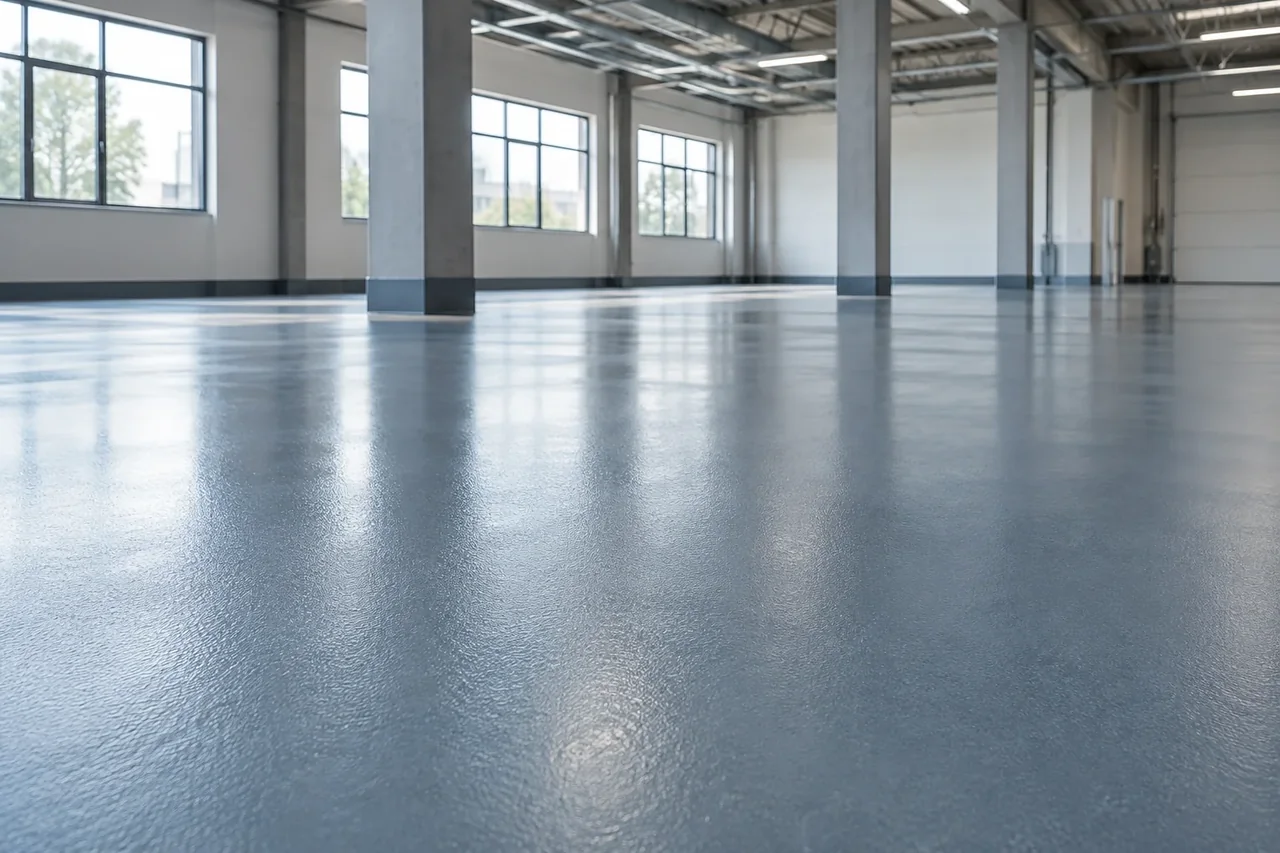
Look at the floor beneath this processing line. It has a continuous matte surface, made with a three-part polyurethane cement screed. The first component is a milky white, castor-oil-based polyol emulsion. Polymeric MDI is the hardener. The third component is a dry blend of cement, hydrated lime, quartz and pigment. The screed goes over a prepared substrate. The condition of the concrete and the chosen flooring system determine the preparation, the layer thickness and whether a primer is needed. Once combined, the three parts form a pigmented screed. Here the mix is grey. The applicator spreads and levels it to form an even layer. In food and beverage plants, floors can face sudden temperature changes during cleaning. Thermal shock resistance matters here. Resistance to acids and alkalis is also important. Confirm both for the finished floor under its expected service conditions. For formulators, viscosity describes how the emulsion flows. The hydroxyl value helps determine the hardener requirement. These panels come from a D. R. Coats lab trial. Contact D. R. Coats for a sample, technical data or help with your flooring formulation.
An epoxy coating, a polyurethane floor and a cementitious screed ask different things of their ingredients. Open the example closest to your formulation.
Define the substrate, build-up, traffic and service exposure before comparing ingredients. The layers shown are illustrative; actual flooring systems vary.
You are choosing the curing-agent component of a resin floor.
A reactive polyamide curing agent for epoxy resins with medium to low viscosity.
Documented applicationsTank and pipe coatings · Metal/plastic adhesives · Flooring · Concrete repair
A low-viscosity reactive polyamide curing agent for epoxy resins.
Documented applicationsMarine coatings · Tanks · Flooring · Encapsulation · Concrete repair
Both grades list flooring, but their complete documented uses differ. Review each curing agent with the proposed epoxy resin and its stated mixing basis.
Assess the resin–curing-agent pair, substrate adhesion, application viscosity, working time and cure under the intended conditions.
You need a castor-oil-based polyol for a polyurethane flooring formulation.
Branched, solvent-free castor-oil-based polyol with ether linkages.
Documented applicationsHeavy-duty floors · Steel/concrete coatings · Pipe coatings
Branched, solvent-free polyol based on castor oil.
Documented applicationsFloors · Topcoats · Sealants · Protective coatings
Drothane 1145 specifically lists heavy-duty floors; Drothane 1150 lists floors and topcoats. Review hydroxyl value and supplied viscosity together with the proposed co-reactant.
Evaluate the complete reactive formulation, including mixing basis, application conditions, cure and the required surface properties. A raw-material value is not a finished-floor result.
You are developing a three-component cementitious polyurethane floor.
Castor-oil-based polyol emulsion for matt, three-component cementitious polyurethane screeds.
Documented applicationsMatt cementitious PU flooring
Phthalate-free, castor-oil-based polyol emulsion for matt, three-component cementitious polyurethane screeds.
Documented applicationsMatt cementitious PU flooring
Both grades are described for matt, three-component cementitious PU screeds. Drothane 2763 additionally has a documented phthalate-free formulation.
Review the complete screed formulation and mixing sequence, placement, working time and cure. Check the finished floor against the intended service exposure.
You are considering a polyaspartic component for a two-component flooring formulation.
Polyaspartic ester with amine functionality for two-component polyurethane and polyurea coatings.
Documented applicationsLarger-area flooring
Drospartic 302 specifically lists larger-area flooring. Its polyaspartic role differs from a castor-oil polyol or epoxy curing agent.
Discuss the intended co-reactant, mixing basis and working time needed for the application area. Evaluate the cured formulation and return-to-service requirements.
These are selection examples, not tested systems or customer case studies. Confirm grade suitability in the complete formulation and intended process.
Select a layer in the diagram or use the labelled controls to explore its role.
The concrete is the foundation of the system. Its condition, moisture and preparation affect what can be applied over it. A coating cannot be selected independently of this surface.
What is the substrate, and how will its condition and moisture be checked?
The primer connects the prepared substrate to the following layer. Its compatibility and overcoating window need to be considered with the body coat, rather than as a separate purchase.
Which primer and body-coat chemistries will be used together?
The main layer gives the system its build. An epoxy coating, cementitious polyurethane floor and decorative aggregate binder are different formulation routes, with different mixing and placement needs.
What floor construction and application thickness are you developing?
The exposed surface is where appearance, cleaning, traffic and service exposure meet. Evaluate these requirements on the cured floor system, including the planned finishing coat where one is used.
What will the floor be exposed to, and when must it return to service?
Illustrative layers shown separated and not to scale; actual systems vary. Layer selection and compatibility require application-specific evaluation.
How to compare polyol selection properties →
Answer only what you know. Review and edit the summary before continuing to the enquiry.
The summary updates as you answer.
Write my own enquiryThese answers prepare a discussion brief; they do not select or approve a grade. Your draft stays in this browser tab.